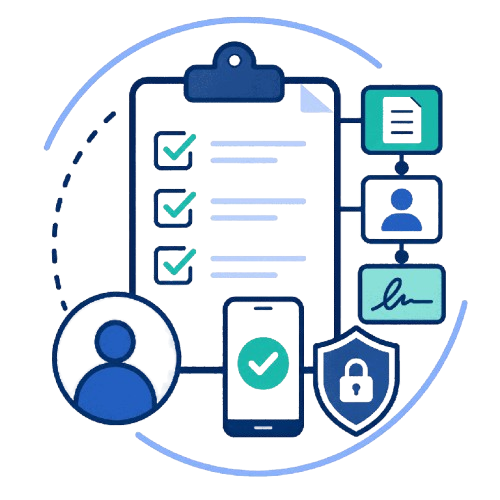
Digital Forms & Workflow Management

Overview

A Case Study on Simplifying Patient Intake with a Centralized Digital Forms & Workflow Management Platform

The healthcare organization needed a more structured approach to managing patient forms, intake documentation, and the workflows for distributing them. With multiple forms and varying documentation requirements, managing these processes efficiently required a centralized solution that could standardize form creation, organize forms into workflows, distribute them to patients, and track submitted responses. We developed a centralized digital forms and workflow management platform that brings these activities together into a single system. The platform enables administrators to create and categorize forms, build reusable workflows, send form packages to patients, configure submission and verification rules, and monitor completed responses.

Requirements

Our solution

Managing different types of patient documentation requires consistent organization and easy access. The organization needed a way to create, categorize, activate, deactivate, update, and manage forms from a centralized interface.

We developed a centralized forms and workflow management platform that transformed individual form management into a structured digital intake process.

The platform is organized around three core areas: Forms, Prospect Management, and Workflow Management. Together, these modules provide administrators with the tools required to create forms, organize them into workflows, distribute those workflows to patients, and monitor submitted responses.

Different patients may require different sets of forms depending on their situation. Managing these forms individually can create unnecessary administrative work and make it difficult to maintain a consistent intake process.

The Forms module gives administrators complete control over the organization's digital forms. Users can create form categories, build individual forms, define their status and expiry, assign optional classifications, identify forms intended for patient intake, and maintain descriptions for internal management.

Once forms are sent to patients, administrators have no visibility into who has received them and what information has been submitted.

Rather than treating every form as a separate task, the platform allows administrators to create workflows that package multiple forms into a defined process. Administrators can configure the workflow's name, status, validity period, category, and description before connecting the required forms. This creates a repeatable process for distributing documentation and managing patient intake activities.

Results:

The centralized forms and workflow platform established a more structured approach to managing digital patient intake and documentation.

By bringing form creation, categorization, workflow configuration, patient distribution, and response tracking into a single system, the solution reduced the need to manage these activities as disconnected processes. The workflow model also created a more standardized way to deliver groups of forms to patients and manage the associated documentation lifecycle.
The configurable workflow controls gave administrators greater operational flexibility, while centralized prospect and response tracking improved visibility into the intake process.

Forms can be organized into predefined workflows, creating a consistent process for collecting required patient information.

Administrators can track patients who have received workflows and access their completed responses from a centralized system.

Submission limits, verification, link validity, and payment-related behavior can be configured according to operational requirements.

Centralized form and workflow management gives administrators one place to configure, maintain, and monitor the documentation process.